Triage Your Busy Life
- Feb 2
- 3 min read

Congratulations, you made it through the first month of 2026!
While January is done and dusted, the reality is that the work year has just begun. Somewhere down the line, many of us will most likely get burnt out and the enthusiasm we might have had at the start of the year towards our work might start to dwindle. This post will hopefully shed light on a system of how you can effectively balance the many tasks and responsibilities that come with the different roles you hold so that you thrive during your work week.
A few years ago, I discovered the triage system and although I was unaware of the term at the time; I, certainly, was to a large extent applying the core principles of this technique in how I approached my work and family life.
The Triage System
“The triage system is a universally accepted and objective way to prioritise treatment in the Hospital Emergency Centre”.
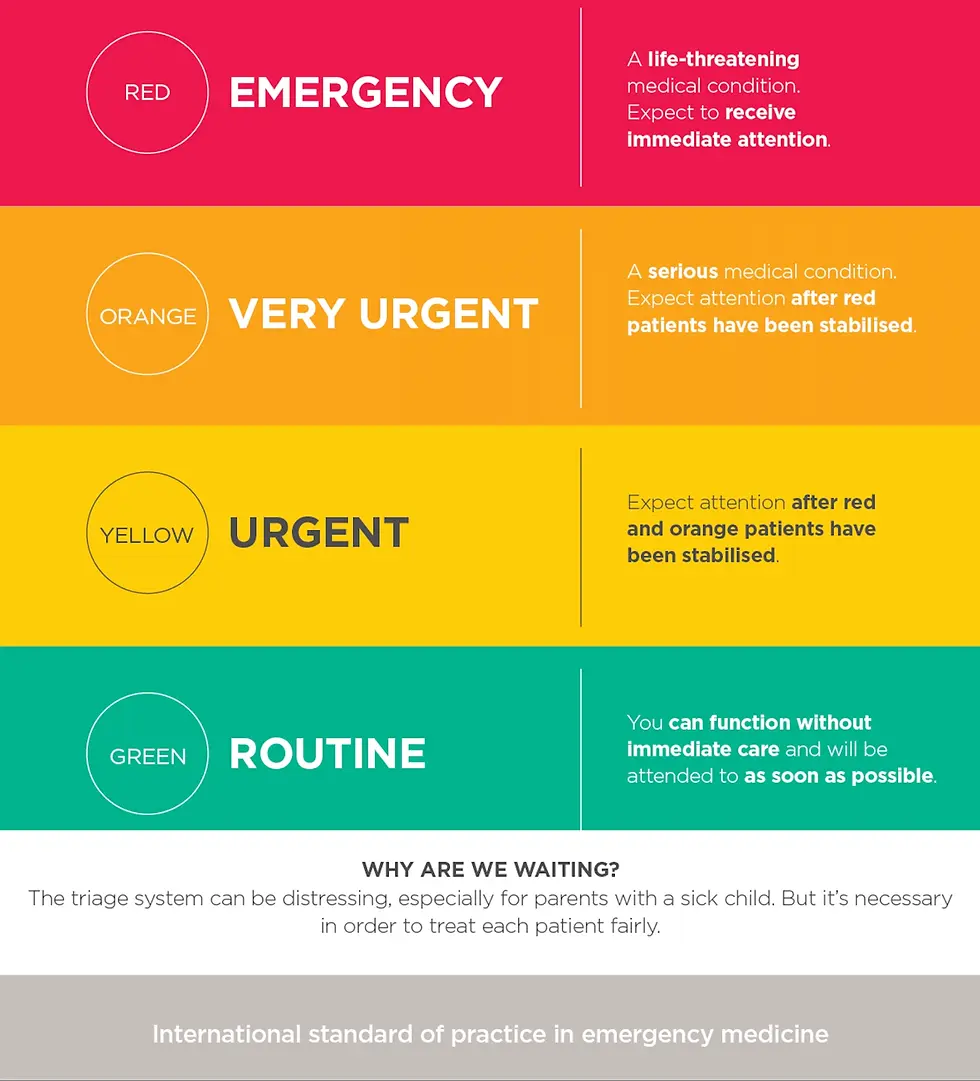
While the triage system was specifically designed for a Hospital Emergency Room, it can also be applied in the commonplace work space and home. In the commonplace work place and home, triaging involves you moving from a frame of mind of “it’s crazy busy” to “ready mode”.
How do you do that?
This is done primarily by preparing yourself mentally for whatever comes through your door that week. By planning your week in advance and knowing what your main priorities are for that particular week, you enable yourself to respond aptly to the crisis’ (and the non-crises’) that might arise.
Ready mode means that you triage by prioritising according to the level of urgency. You must take time to list what your typical red, orange, yellow and green tasks/situations look like so that when they do occur you are READY to tackle them with the level of urgency they deserve. Remember, someone else’s emergency might not necessarily translate into it being yours, thus, not every challenge will require the same mental response.
So, how does this translate practically?
Exhibit A: You have an important deadline due in 48hrs vs an email from a team member requiring feedback about a matter that has just arisen. What do you focus on?
Understanding what is an immediate threat vs what can be put on hold is key in managing stress levels and ensuring that you get to focus on what is of utmost of importance before working through what does not require your immediate attention.
By prioritising tasks, you not only get to complete what is important first, but you also get to manage your stress levels and keep calm as you go through your daily/weekly to do list.
It is imperative that we understand fully what our “reds” in our weekly/daily to do lists are so we can focus our time and energies on those before moving to the “oranges”, then the “yellows” and lastly the “greens”.
It is important to note, that what is often “noisiest” is not always what’s most important and thus not urgent.
Once we have understood our “reds”, especially those that pop up consistently, we can then plan ahead and design systems to mitigate these issues before they happen. This eliminates the “surprise” factor because you are mentally and practically ready for the challenge before it happens.

The first step in triaging is getting into the habit of planning your week, take time at the start of each week to plan what your reds, oranges, yellows and greens are. You can categorise them accordingly for work, home and/or studies. This will allow you to focus and prepare yourself mentally for the week ahead.
As you step into the new month, remember that you were not created to "just make it" through each day but to live an abundant life. Amongst other things, this means that you need to actively plan and manage your work week so that you can thrive and not just merely survive.
'The thief does not come except to steal, and to kill, and to destroy. I have come that they may have life, and that they may have it more abundantly.'
John 10:10
FN
"In Him we live & breathe & have our being"


Comments